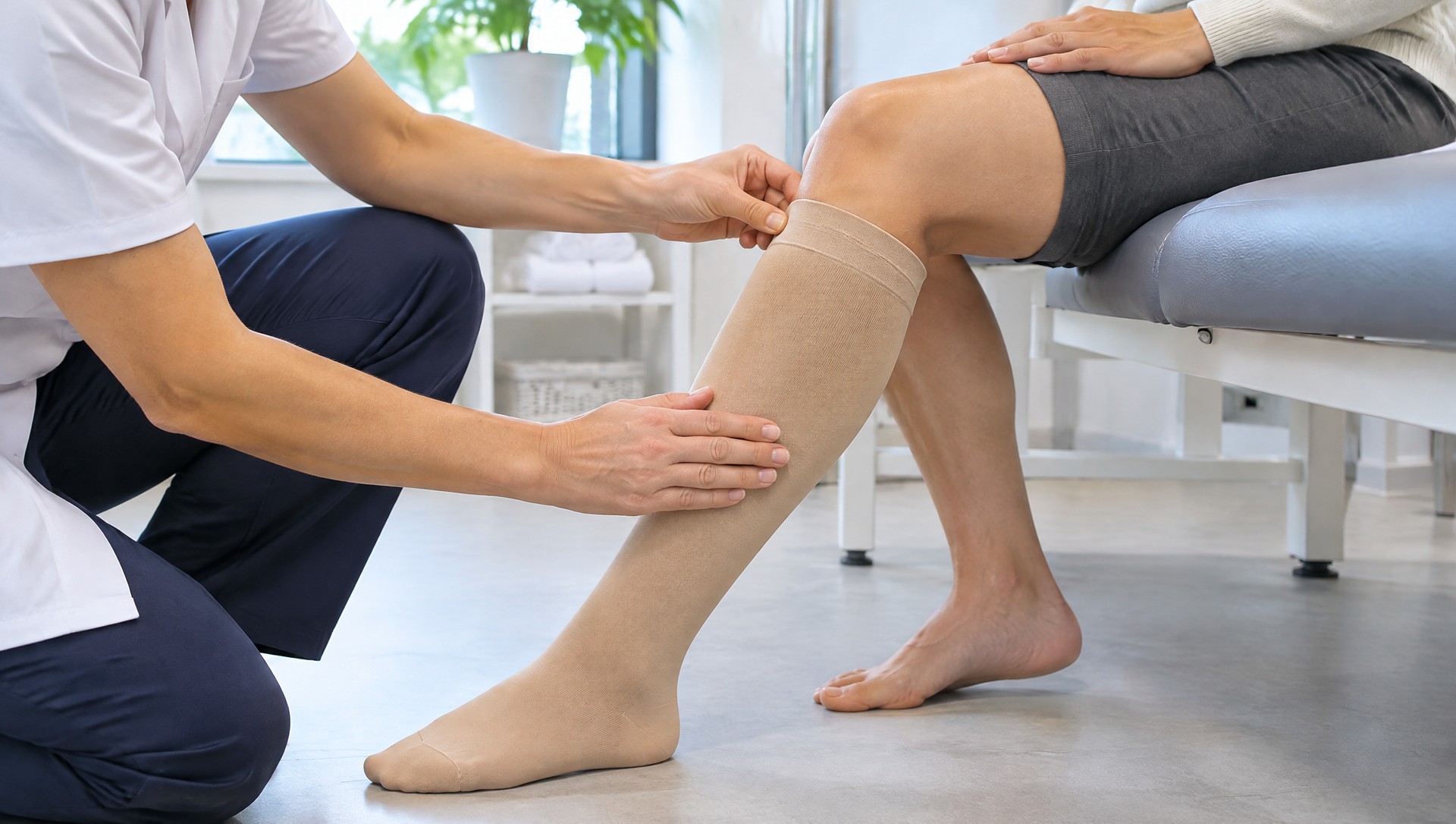
Swelling in your legs or arms can change the way you move, dress and sleep. Maybe your doctor mentioned lymphedema after cancer treatment. Maybe you are heading home from surgery with orders to wear compression. Or maybe your legs ache and swell by the end of every workday. Whatever brought you here, you do not have to sort out compression garments on your own.
At our Hickory office on Tate Boulevard, Orthopedic Appliance Company helps patients find medical-grade compression garments that fit their bodies and their physician's plan. Our certified professionals work with people from Hickory, Newton, Conover, Morganton, Lenoir and across Catawba County and the surrounding foothills, so you can get measured, fitted and followed up close to home.
How Compression Garments Work
A medical compression garment is not simply a tight sleeve or stocking. It is built to apply graduated pressure, which means the squeeze is firmest at the far end of the limb, such as the ankle or wrist, and eases off as it moves up toward the body. That gradient helps encourage fluid to move out of the tissues instead of pooling in one place.
Compression strength is measured in millimeters of mercury (mmHg), and garments are grouped into compression levels. Your physician decides which level fits your condition. Our job is to make sure the garment you wear actually delivers that level, comfortably, on your limb.
Common Garment Types
Depending on your needs, a compression plan may include:
- Knee-high or thigh-high stockings for leg swelling and circulation support.
- Arm sleeves and gauntlets for arm and hand swelling, often after breast cancer treatment.
- Pantyhose-style or waist-high garments when swelling reaches the upper leg or hip.
- Wraps with adjustable straps that some patients find easier to put on and adjust through the day.
Who Can Benefit From Compression in the Hickory Area
People come to us for compression for many different reasons. The right garment depends on the cause of the swelling, so we always start with your physician's diagnosis and orders.
Lymphedema Management
Lymphedema is a long-term swelling caused by lymph fluid that does not drain the way it should. It can follow cancer surgery or radiation, especially when lymph nodes are removed, and it can also develop on its own. Daily compression is often part of a lymphedema plan, along with care from your physician or a lymphedema therapist. A garment that fits well can help keep swelling under control between therapy visits. A garment that fits poorly can dig in, roll down or leave gaps where fluid collects, which is why careful measuring matters so much here.
Post-Surgical Compression
After certain procedures, your surgeon may want you in compression while you heal. It can help manage swelling and support tissue during recovery. The garment type, strength and how long you wear it all depend on the surgery and your surgeon's instructions. We follow those instructions and help you get a garment that you can actually put on, take off and wear as directed.
Diabetic Compression
If you live with diabetes, your legs and feet need extra care. Some people with diabetes deal with swelling, and lighter compression options may be part of their plan. Because diabetes can affect circulation and skin sensation, your physician should check your circulation before you start any compression. Compression is not right for everyone, and certain artery problems can make it unsafe. When it is approved, we pay close attention to seams, pressure points and fit so the garment supports your legs without irritating sensitive skin.
Venous Insufficiency Support
Chronic venous insufficiency happens when the veins in the legs have trouble sending blood back to the heart. It can cause heavy, aching legs, swelling around the ankles and changes in skin color over time. Graduated compression is commonly used to help manage these symptoms. Many people in jobs that keep them on their feet, or seated for long stretches, notice the difference most at the end of the day.
Over-the-Counter Compression vs. Custom-Fitted Medical Garments
You can buy compression socks at most pharmacies and big-box stores, and for some people that is a reasonable place to start. Light, over-the-counter compression may help with mild tiredness or travel. But store-bought compression and medical-grade compression are not the same product, and the difference matters when you are treating a medical condition.
What Over-the-Counter Garments Offer
- Standard sizes based on a few general measurements, such as shoe size or calf width.
- Lighter compression levels in most cases.
- No professional check that the pressure is right for your limb shape.
What Medical-Grade Garments Offer
- Compression levels prescribed by your physician to match your diagnosis.
- Garments chosen from your own measurements, with ready-to-wear medical sizes when they fit well and closer fitting when your limb shape needs it.
- Professional fitting and follow-up, so the garment keeps doing its job as swelling changes.
Limbs affected by lymphedema or long-term swelling often do not match standard size charts. A garment that is too loose may not help. One that is too tight in the wrong spot can cause discomfort or skin problems. If you want to understand the bigger picture, our article on custom vs. off-the-shelf orthotics and why fit matters explains how the same idea applies across many of the devices we provide.
Our Compression Fitting Process
We keep the process simple and centered on you. Every patient is different, but most visits follow the same basic steps.
Evaluation
We review your prescription and your physician's notes, then talk with you about your symptoms, your daily routine and any trouble you have had with garments in the past. If you struggle with hand strength or reaching your feet, tell us. It can affect which style makes sense.
Measurement
Our certified professionals take measurements of the affected limb. Measurements are usually most useful when swelling is at its lowest, which for many people is in the morning, so ask about timing when you book.
Fitting
Once your garment is ready, we check how it fits on your body and show you how to put it on and take it off. We also go over care, washing and when to call us if something does not feel right.
Follow-Up and Replacement
Swelling can change over time, and garments wear out with daily use and washing. We follow your physician's orders and can talk with you about when it may be time to re-measure or replace a garment. You can also explore the other supports we offer on our orthotics page.
Insurance
Orthopedic Appliance Company accepts most major insurances, including Medicare and Medicaid. A prescription is required to file any insurance claim, so please bring your prescription, your insurance card and any forms your physician gave you. If you have lymphedema and your doctor orders the items, Medicare Part B may cover gradient compression garments, both standard and custom-fitted (Medicare, Lymphedema Compression Treatment Items). Coverage for other conditions varies by plan. You can see the list of plans we work with on our insurance page, and our staff is glad to help you sort out your benefits before your visit.
What Our Patients Say
Our Hickory patients often tell us that attentive care and a good fit made the difference.
"Outstanding, right to the point, and plenty of experience working with doctors. They read the order and asked exactly what was wrong. Great folks, and quick."
Matt S., Hickory patient
"I've been going to Orthopedic Appliance Company for several years now. They're always so extremely helpful and concerned about my complete satisfaction with the product."
Daryl M., Hickory patient
Frequently Asked Questions
Do I need a prescription for compression garments?
You can buy light compression without one. For medical-grade garments and any insurance claim, you will need a prescription from your physician. The prescription also tells us the compression level and garment type your physician wants you to wear.
How long does a compression garment last?
It depends on how often you wear and wash it. Daily-wear garments lose some of their stretch over time. Many patients replace their garments every few months, but your physician and your insurance plan may have their own guidelines. We can help you plan for replacements.
Can I just buy compression socks at the store instead?
For mild tiredness or travel, store-bought compression may be enough. If you have lymphedema, venous insufficiency, diabetes or a recent surgery, talk with your physician first. Medical conditions usually call for a specific compression level and a careful fit.
Is compression safe if I have diabetes?
It can be for many people, but not for everyone. Your physician should check your circulation before you start. Certain artery problems can make compression unsafe, so we fit medical compression garments when your physician has ordered them.
Do you see patients from Morganton and Lenoir?
Yes. Patients from Morganton, Lenoir, Newton, Conover and the nearby counties are welcome at our Hickory office. Call (828) 348-1960 to schedule a visit.
Get Fitted for Compression in Hickory
If swelling is getting in the way of your day, or your physician has ordered compression, we are here to help you find a garment that fits and that you can live with. Call our Hickory office or contact Orthopedic Appliance Company to schedule your evaluation and fitting.
Visit Our Hickory Office
Orthopedic Appliance Company 910 Tate Blvd SE, Suite 103 Hickory, NC 28602 Phone: (828) 348-1960 Hours: Monday through Friday, 8am to noon and 1pm to 5pm
Proudly serving Hickory, Newton, Conover, Morganton, Lenoir and all of Catawba County.